
Quick Summary
- Ants don’t follow each other — they follow invisible chemical signals called pheromones. Spray the ant, and the trail lives on.
- Pheromone disruption targets the communication system of the colony, not just the individual insects — making it the only method that addresses the root cause.
- It’s completely safe for kids and pets, making it the gold standard for eco-conscious homeowners and commercial facilities that can’t afford chemical disruption.
You sprayed the ants on Monday. By Thursday, they were back — marching in the exact same line, across the exact same counter, heading to the exact same spot.
Sound familiar?
Here’s the thing: you didn’t fail. The spray did. And once you understand why, you’ll never look at an ant problem the same way again.
The answer comes down to one word: pheromones.
What Are Ant Pheromones? (And Why They’re the Real Problem)
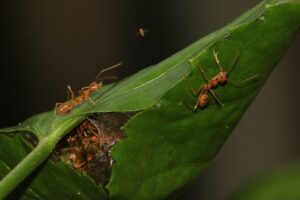
Think of pheromones as invisible text messages. When a scout ant finds food, it doesn’t just grab it and go. It lays down a chemical trail on the way back to the colony — a scent signal that essentially says, “Hey everyone, follow me this way.”
Every ant that walks that path reinforces the message. The trail gets stronger. The column gets longer. And that’s what you’re seeing when you watch a line of ants march across your kitchen floor.
The trail is the problem — not the individual ants.
When you spray a pesticide on the visible ants, you eliminate the messengers. But the message — that chemical highway — is still sitting on your floor, your countertop, and your wall. New ants from the colony simply pick up where the old ones left off.
That’s why they keep coming back to the same spot. Every. Single. Time.
The “Rebound Effect”: Why Traditional Sprays Make Things Worse
Here’s something most pest control companies won’t tell you: aggressive chemical sprays can actually trigger a rebound effect.
When a colony senses a threat, it doesn’t shut down. It adapts. The queen can accelerate egg production to compensate for the workers lost to your spray. In some species, a stressed colony will even split — a process called budding — creating multiple new colonies from one.
You spray once. You potentially end up with two problems.
This isn’t a scare tactic. It’s basic entomology, and it’s exactly why the most effective pest control strategies focus on disrupting the colony’s communication, not just its population.
How Pheromone Disruption Actually Works
Professional pheromone-based pest control works in two ways, and understanding both is key.
1. Pheromone Traps
These use synthetic versions of the insects’ own chemical signals to lure them into a contained area. The ants (or cockroaches, or other target pests) follow what they believe is a legitimate trail, but it leads them away from your living spaces and into a controlled trap. No colony split. No rebound.
2. Trail Disruption
This is where it gets really elegant. By introducing competing or interfering chemical signals, a trained professional can essentially “jam” the ant’s GPS. The trail breaks down. Scouts can’t communicate. The colony loses its ability to organize foraging — and without food, it collapses from the inside out.
This is the core principle behind integrated pest management ant control — a science-based approach that targets behavior and biology, not just bodies.
Is Pheromone Pest Control Safe for Dogs and Cats?
This is the question we hear most often from families, and the answer is straightforward: yes.
Pheromones are species-specific chemical signals. The synthetic compounds used in pheromone traps and disruptors are designed to mimic insect communication molecules — structures that have zero biological relevance to mammals. Your dog’s nose won’t even register them as anything meaningful, let alone harmful.
Compare that to traditional pyrethroid sprays. Those are broad-spectrum neurotoxins. They work by disrupting the nervous systems of insects — but they can also affect cats (who are especially sensitive), small dogs, and young children who crawl on treated surfaces.
The contrast is stark:
| Method | Targets | Risk to Pets & Kids | Addresses Root Cause? |
| Chemical Spray | Individual insects | Moderate to High | No |
| Pheromone Disruption | Colony communication | None | Yes |
| Bait Stations (IPM) | Colony via foragers | Very Low | Yes |
If you’re looking for a pet safe ant killer that actually works at the source, pheromone-based treatment isn’t just a safer option — it’s a smarter one.
Why Do Ants Keep Returning to the Same Spot After I Spray?
We touched on this above, but it’s worth spelling out clearly because it’s the #1 frustration we hear from homeowners who’ve tried to handle this themselves.
When you spray, you kill the visible ants. But you do nothing to the pheromone trail they laid down. That trail can persist for hours or even days, depending on the species and the surface. New workers from the colony simply follow the existing chemical highway right back to where the old ones were.
The only way to stop the cycle is to eliminate the trail itself — and the colony that keeps producing it.
That’s not something a hardware store spray can do. It requires understanding the specific ant species you’re dealing with, the location of the colony, and the right combination of disruption and baiting to collapse the entire system.
Pheromones Beyond Ants: Cockroaches and Rodents
The same science extends well beyond ants.
Cockroaches use aggregation pheromones — chemical signals that tell other roaches, “this is a safe harborage site.” That’s why you’ll find dozens of them clustered in the same crack or behind the same appliance. Pheromone-based monitoring traps exploit this behavior to detect infestations early and track population size over time, allowing for targeted treatment rather than blanket chemical application.
Rodents use scent trails too — particularly urine-based pheromones that mark travel routes between nesting and feeding areas. Disrupting these pathways, combined with exclusion strategies that seal entry points, is far more effective long-term than simply setting snap traps.
This is the foundation of a true year-round pest prevention strategy — one that monitors chemical signals, adapts to seasonal behavior changes, and keeps your home protected without repeated chemical exposure.
What This Means for Commercial Facilities
If you manage a restaurant, office, or warehouse, you already know that a single pest sighting can cost you a health inspection, a bad review, or worse.
Pheromone monitoring is particularly valuable in commercial settings because it’s discreet, non-disruptive, and data-driven. Traps can be placed along known pest travel routes without any chemical odor, without closing your facility, and without alarming staff or customers.
More importantly, pheromone monitoring gives you early warning. You catch an emerging problem before it becomes an infestation — which is exactly what health code compliance requires. This is the heart of what a professional integrated pest management ant control program looks like in practice.
The Honest Truth About DIY Pheromone Products
You’ll find pheromone traps at hardware stores — little sticky cards with synthetic attractants for moths, fruit flies, and some ant species. They work, to a degree, for monitoring.
But here’s what they can’t do: they can’t tell you where the colony is, how large it is, what species you’re dealing with, or how to disrupt the trail network that’s already established in your walls and foundation.
That’s where professional assessment matters. Not because we want your business (though we certainly appreciate it), but because misidentifying the ant species alone can send your entire treatment strategy in the wrong direction. Carpenter ants require a completely different approach than odorous house ants or pavement ants — and treating one like the other is exactly how you end up with a bigger problem six weeks later.
Conclusion: Stop Fighting the Symptoms. Target the System.
If there’s one thing to take away from all of this, it’s simple: ants aren’t your problem. The pheromone network they’ve built inside your home is.
Every time you spray and watch them come back, you’re fighting the symptom. Pheromone disruption — done correctly, by someone who understands the biology — targets the system. It collapses the colony’s ability to communicate, forage, and sustain itself.
And it does it without putting your kids, your pets, or your peace of mind at risk.
At Affordable Pest Solutions LLC, Seth and Sandy built this business on one principle: honesty and integrity. That means telling you when a DIY solution isn’t going to cut it, explaining exactly what we’re doing and why, and making sure you feel confident — not just pest-free.
If you’re ready to stop the cycle for good, we’d love to help. We offer free inspections and estimates, and we’ll walk you through exactly what’s happening in your home and what it takes to fix it permanently.
Contact us today for your free inspection →
Veteran and senior discounts available. Warranties on select services.
 Creating an Effective Ant-Free Zone: The Zone Defense Guide to Permanent Ant Control