
Carpenter Bee Control Services in Northwest New Jersey
Veteran and Senior Discounts | Warranties Available | Free Quotes
Carpenter bee control services encompass the identification, treatment, and prevention of wood-boring insect damage caused by Xylocopa virginica, the Eastern Carpenter Bee. Unlike termites that consume wood for nutrition, carpenter bees excavate perfectly circular ½-inch diameter galleries in untreated softwood solely to create nesting chambers for their larvae. In Northwest New Jersey’s Morris, Sussex, and Warren Counties, professional carpenter bee control focuses on protecting high-value wood structures—including cedar siding, log cabins, and Victorian trim—while preventing secondary structural damage caused by woodpeckers that excavate bee galleries to feed on larvae. Effective control requires understanding the species’ biology, regional habitat preferences, and the timing of treatment applications to preserve both the aesthetic and structural integrity of wood-based architecture.

Protecting Your Northwest NJ Property: Specialized Solutions by Structure Type
Carpenter bee activity creates cascading risks that vary by construction type and location. Professional control services in Northwest New Jersey address these specific vulnerabilities:
Professional Carpenter Bee Treatment Services – Comprehensive gallery treatment and population management for active infestations across Morris, Sussex, and Warren Counties.
Woodpecker Damage Prevention & Repair – Addressing the secondary threat of woodpecker excavation that can “unzip” siding and compromise structural envelopes.
Log Cabin & Cedar Home Pest Protection Plans – Specialized preservation protocols for Lake Mohawk, Sparta, and highland community properties with exposed softwood construction.
Morris County Structural Pest Control – Integrated wood-boring insect management for Mendham, Chester, and Roxbury Township properties.
Sussex County Wood-Boring Insect Services – High-elevation home protection for Vernon, Andover, and Stanhope areas where untreated wood exposure is common.Warren County Seasonal Home Protection – Year-round monitoring and preventive treatment for Hackettstown, Washington, and Phillipsburg Victorian and farmhouse structures.
Identifying Carpenter Bees: Physical Characteristics & Behavior
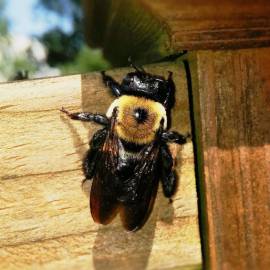
Carpenter bees are frequently confused with bumblebees, but several distinct characteristics differentiate the species. Adult Xylocopa virginica measure ¾ to 1 inch in length with robust, black bodies. The key visual identifier is the abdomen: carpenter bees have a shiny, hairless black abdomen, while bumblebees display a fuzzy, yellow-banded abdomen.
Behavioral patterns further distinguish the species. Male carpenter bees exhibit aggressive territorial hovering near nest sites, often dive-bombing approaching humans or animals. Despite this intimidating display, males lack stingers and pose no physical threat. Females possess stingers but demonstrate docile behavior unless directly handled or trapped. The female’s primary focus during spring and early summer is excavating and provisioning nest galleries.
The most definitive evidence of carpenter bee activity is the presence of perfectly circular entry holes approximately ½ inch in diameter, typically located on horizontal or upward-facing wood surfaces. Fresh excavation produces piles of coarse sawdust (frass) below entry points. Unlike the fine powder produced by termites, carpenter bee frass consists of small wood shavings mixed with fecal pellets. Active galleries also attract attention from hovering males defending territory and females entering and exiting during provisioning activities.
The Biology of Wood Destruction: How Galleries Are Built
Carpenter bee damage follows a predictable architectural pattern that compounds over multiple generations. The female initiates excavation by chewing a circular entrance hole perpendicular to the wood grain. After penetrating approximately ½ to 1 inch, she abruptly turns 90 degrees and tunnels parallel to the grain, creating a gallery that may extend 4 to 6 inches in the first season.
Within this gallery, the female constructs a series of brood cells separated by partitions made of chewed wood pulp and saliva. Each cell receives a provision mass of pollen and nectar, upon which a single egg is laid. A mature gallery may contain 6 to 8 individual cells. Larvae develop throughout summer, pupate in late summer, and emerge as adults in late August or September. These new adults often remain in the gallery through winter, emerging the following spring to mate and establish new nests.
The critical factor in long-term structural damage is gallery reuse and expansion. Carpenter bees demonstrate strong site fidelity, with females preferentially returning to existing galleries rather than excavating new ones. Over multiple generations, a single entry hole may lead to a network of interconnected tunnels extending several feet in length. This cumulative excavation compromises structural integrity far beyond the cosmetic impact of surface holes, particularly in load-bearing timbers, support posts, and fascia boards.
Why Northwest NJ Homes Are Particularly Vulnerable
Northwest New Jersey’s residential architecture creates ideal conditions for carpenter bee colonization. The region’s wooded highlands and lake communities feature a high concentration of exposed softwood construction that carpenter bees preferentially target.
Log cabin construction, prevalent around Lake Mohawk, Lake Hopatcong, and throughout Sussex County’s highland communities, presents maximum vulnerability. These structures feature extensive exposed softwood surfaces—often untreated pine or cedar—with horizontal log faces that provide optimal drilling angles. The rounded surfaces and log-end grain sections are particularly attractive to nesting females.
Cedar siding, popular throughout Morris County communities like Mendham, Chester, and Long Valley, offers another prime target. While cedar’s natural oils provide some insect resistance, weathered or aged cedar loses these protective compounds. Unpainted or unstained cedar siding on wooded properties experiences frequent colonization, particularly on south and west-facing exposures that receive maximum solar warming.
Victorian-era homes throughout Warren County communities—including Hackettstown, Washington, and Belvidere—feature elaborate wooden trim, corbels, and decorative fascia elements. These architectural details often consist of softer woods like pine, and their horizontal surfaces and intricate joinery create numerous ideal drilling sites. The historic preservation requirements for these properties often limit treatment options, requiring specialized approaches that maintain aesthetic integrity.
Deck and fence structures throughout the region face similar risks. Untreated deck railings, pergola beams, and privacy fence posts provide abundant nesting habitat. Properties with extensive outdoor wooden structures may support populations of dozens of active females, each excavating and expanding galleries annually.
The Woodpecker Connection: Understanding Secondary Predation
The relationship between carpenter bees and woodpeckers creates a damage cascade that transforms a cosmetic nuisance into a structural emergency. This ecological connection is frequently overlooked in conventional pest control approaches but represents the primary threat to property value in Northwest New Jersey.
Carpenter bee larvae are protein-rich food sources that overwinter in galleries, remaining accessible to woodpeckers when other insect prey becomes scarce. Downy woodpeckers, hairy woodpeckers, and red-bellied woodpeckers—all common in Morris, Sussex, and Warren Counties—have learned to associate carpenter bee entry holes with concentrated food sources. During late fall, winter, and early spring, woodpeckers systematically excavate these galleries.
The damage pattern is distinctive and devastating. Woodpeckers use their chisel-like beaks to expand the ½-inch entry hole into an elongated trench that follows the gallery system. On cedar siding or log cabin walls, this creates a “unzipping” effect where entire boards or log sections are shredded to expose the tunnel network. A single woodpecker can destroy a 2-foot section of siding in a matter of hours while excavating a carpenter bee gallery.
The timing of this secondary damage is critical to understanding control strategies. Carpenter bees are active from April through September, with peak gallery construction in May and June. Larvae develop through summer and pupate in August. By October, galleries contain mature larvae or newly emerged adults overwintering in the tunnels. Woodpecker predation intensifies from November through March, precisely when the galleries are fully stocked with prey but homeowners are least likely to notice activity.
Professional carpenter bee control services in Northwest New Jersey therefore focus on eliminating the food source before woodpecker predation begins. Treatment timing in August through early October—after bee activity declines but before woodpecker season intensifies—provides maximum protection. This preventive window is frequently missed in reactive pest control approaches that only address visible bee activity.e to ant activity, extending the effectiveness of chemical treatments and reducing the frequency of required applications.
Treatment & Prevention Methodologies: Professional Approaches
Effective carpenter bee control requires understanding why conventional homeowner approaches fail and how professional methodologies address the unique architecture of gallery systems.
Why Surface Sprays Are Ineffective
Liquid insecticide sprays applied to wood surfaces fail to control carpenter bees because the gallery architecture prevents penetration. The upward turn and horizontal tunnel orientation mean that gravity pulls liquid treatments away from larval chambers. Bees entering and exiting the gallery make minimal contact with surface residues. Additionally, the female spends the majority of her time deep within the gallery, protected from external treatments.
Dust Application Protocols
Professional treatment relies on pressurized insecticidal dust formulations—typically Drione (silica gel-based) or Delta Dust (diatomaceous earth with synergized pyrethrin). These products are applied using specialized hand dusters or power dusters that inject dust deep into gallery systems. The dust particles adhere to gallery walls and bee bodies, providing both contact kill and residual control.
The application technique is critical. Technicians inject dust directly into entry holes, filling the initial vertical shaft and forcing dust into the horizontal gallery. The dust desiccates larvae, kills overwintering adults, and creates a barrier that prevents gallery reuse the following season. A properly treated gallery remains protected for 6 to 12 months.
Timing Considerations: The “Don’t Plug” Rule
A common homeowner mistake is immediately plugging carpenter bee holes with wood filler, caulk, or dowels. If galleries contain live bees—whether active adults or overwintering individuals—plugging the entry forces them to chew a new exit hole. This often results in interior emergence through drywall or the creation of multiple new exit points through adjacent siding.
Professional protocols follow a “treat, wait, plug” sequence. Galleries are treated with dust in late summer or early fall. Technicians then wait 4 to 6 weeks to ensure all gallery occupants are eliminated. Only after this waiting period are holes filled with wood putty or dowel plugs. This prevents re-infestation while avoiding forced interior emergence.
Preventive Surface Treatments
While surface sprays don’t eliminate existing infestations, preventive liquid treatments applied to vulnerable wood surfaces in early spring can deter new gallery excavation. Synthetic pyrethroid formulations create a repellent barrier that discourages females from initiating drilling. These treatments are most effective on previously untouched wood or on structures where existing galleries have been properly treated and sealed.
Trap-Out Systems
Specialized carpenter bee traps utilize the bees’ natural flight patterns to capture adults. These traps feature angled entry holes that lead to a collection chamber. While traps can reduce local populations, they function best as supplemental control in conjunction with gallery treatment rather than as standalone solutions.
Preserving Historic & High-Value Wood Structures
Carpenter bee control in Northwest New Jersey frequently involves properties where wood aesthetics and historic character are primary concerns. Log cabins, Victorian homes, and cedar-sided structures require treatment approaches that balance pest elimination with preservation of visual and structural integrity.
Log Cabin-Specific Considerations
Log homes present unique challenges because the entire exterior envelope consists of carpenter bee-preferred habitat. Treatment protocols must address not only active galleries but also the prevention of new colonization across hundreds of square feet of exposed wood surface. Many log home owners prefer to maintain the natural wood appearance rather than applying opaque stains or sealants, requiring ongoing monitoring and treatment programs.
The chinking and caulking joints between logs create additional vulnerability. Carpenter bees occasionally excavate galleries that intersect these joints, compromising the seal and allowing moisture intrusion. Professional treatment includes inspection of joint integrity and re-sealing when necessary.
Victorian Trim Preservation
Historic Victorian homes feature decorative wooden elements—gingerbread trim, corbels, turned porch posts—that are both architecturally significant and highly vulnerable to carpenter bee damage. Many of these elements are original to the structure and irreplaceable. Treatment must be precise to avoid staining or discoloration of painted surfaces while ensuring complete gallery elimination.
In some cases, severely damaged trim elements require removal, gallery treatment, wood consolidation or dutchman repairs, and reinstallation. This level of intervention requires coordination between pest control professionals and restoration carpenters.
Cedar Siding Maintenance
Cedar siding protection combines pest control with ongoing maintenance protocols. Properly maintained cedar—treated with penetrating stains or sealants every 3 to 5 years—experiences significantly lower carpenter bee activity. Professional services often include recommendations for protective coatings that preserve the wood’s natural appearance while providing insect resistance.
Our Service Area: Carpenter Bee Control Across Northwest New Jersey
Professional carpenter bee control services are available throughout the three-county region of Northwest New Jersey, with specialized expertise in the unique architectural and ecological conditions of each area.
We serve the following areas:
Each county presents distinct carpenter bee control challenges based on prevalent construction types, elevation, and woodland density. Local expertise ensures treatment protocols address the specific vulnerabilities of your property type and location.
Complete Exterior Protection Strategy
Professional carpenter bee control functions most effectively as part of an integrated approach to exterior home protection. Related services that address connected vulnerabilities include comprehensive structural pest management and seasonal monitoring programs.
Return to All Pest Control Services – Explore comprehensive exterior pest management solutions for Northwest New Jersey properties.
Carpenter bee management protects not only against immediate wood damage but also against the cascading structural threats that develop when pest activity intersects with regional ecology and architecture. Understanding these connections—between bee biology and woodpecker predation, between construction type and vulnerability patterns, between treatment timing and long-term effectiveness—separates preservation-focused professional services from conventional reactive pest control.
Ready to Protect Your Property?
Don’t wait until woodpeckers turn carpenter bee holes into major structural damage. The optimal treatment window is closing—schedule your inspection before fall ends and winter predation begins.
How much damage can carpenter bees actually cause to a home?
Single-season damage is typically cosmetic, limited to surface holes and shallow galleries. However, multi-generational gallery expansion over 3 to 5 years can compromise structural members. A single gallery system may extend 10 feet or more through a support beam or fascia board. The greater threat in Northwest New Jersey is secondary woodpecker damage, which can destroy entire sections of siding or log walls in hours while excavating bee galleries for larvae.
What’s the difference between carpenter bees and bumblebees?
Carpenter bees have shiny, hairless black abdomens, while bumblebees have fuzzy, yellow-banded abdomens. Behaviorally, carpenter bees are solitary nesters that excavate wood galleries, while bumblebees are social insects that nest in existing cavities like abandoned rodent burrows. Carpenter bees demonstrate territorial hovering behavior near nest sites, while bumblebees are typically observed foraging on flowers.
Can I treat carpenter bee holes myself with store-bought spray?
Surface sprays are largely ineffective because they don’t penetrate the upward-turning gallery architecture. Liquid treatments run out of the hole due to gravity, failing to reach larval chambers or overwintering adults deep in the tunnel. Professional control requires pressurized dust applications that coat gallery walls and provide residual control. DIY surface treatments may kill a few entering adults but leave the infestation intact.
Why shouldn’t I immediately plug carpenter bee holes?
Plugging active galleries traps live bees inside, forcing them to chew new exit holes. This often results in interior emergence through drywall or the creation of multiple new exit points through adjacent siding, multiplying the visible damage. Professional protocols treat galleries with insecticidal dust, wait 4 to 6 weeks to ensure elimination, then plug holes to prevent reuse.
When is the best time to treat carpenter bee infestations?
The optimal treatment window is late summer to early fall (August through September) after bee activity declines but before woodpeckers begin excavating galleries for overwintering larvae. Spring treatments (April-May) can reduce active nesting but miss overwintering populations. Fall treatments eliminate both current and overwintering generations while preventing the secondary woodpecker damage that occurs from November through March.
Are carpenter bees dangerous to people or pets?
Male carpenter bees are aggressive in territorial defense but lack stingers and cannot harm humans or animals. Females possess stingers but are docile and rarely sting unless directly handled or trapped. The primary threat is to property rather than health—specifically the structural and cosmetic damage to wood siding, trim, decks, and support members, compounded by subsequent woodpecker excavation.
Do carpenter bees return to the same holes every year?
Carpenter bees demonstrate strong site fidelity, with females preferentially returning to existing galleries rather than excavating new ones. This behavior causes damage to compound over multiple generations, as each year’s occupant extends and expands the gallery network. A single entry hole may lead to several feet of interconnected tunnels after 3 to 5 years of reuse. Proper treatment must eliminate existing populations and seal galleries to prevent recolonization.
Will painting or staining my wood prevent carpenter bees?
Painted or stained wood experiences significantly lower carpenter bee activity compared to untreated surfaces. The finish creates both a physical barrier and a chemical deterrent. However, weathered or damaged finishes lose effectiveness, and carpenter bees will occasionally excavate through thin paint layers. Proper protection requires maintaining finish integrity with reapplication every 3 to 5 years, combined with treatment of any established galleries before sealing.